

What if I told you that a tiny piece of tissue under your tongue could affect your posture, your sleep, your digestion, your anxiety, your jawline… and even how your kids grow?
That’s not an exaggeration.
And after this episode, you’ll never look at your face—or your kids’ faces—the same way again.
In this episode of Real and Natural-ish, I sit down with Kelly, founder and director of MyMio My Health, to talk about myofunctional therapy, tongue ties, airway health, and why the muscles in your face matter so much more than most of us were ever taught.
This conversation is one of those once you see it, you can’t unsee it moments.
My Journey Started with My Kids
More than a decade ago, my first daughter struggled to breastfeed. That led to learning about tongue ties—and eventually, all four of my kids had theirs released as babies.
What I didn’t realize at the time was that tongue ties can be hereditary. And years later, I finally understood why my own tongue couldn’t reach the back of my molars.
That discovery sent me down a rabbit hole that eventually led me to myofunctional therapy—a specialty focused on strengthening and retraining the muscles of the face, tongue, mouth, and airway.
And honestly? Every single appointment blew my mind.
What Is Myofunctional Therapy?
In simple terms, myofunctional therapy helps retrain the muscles that allow you to:
- Breathe properly (through your nose)
- Rest your tongue in the correct position
- Swallow, chew, and eat efficiently
- Sleep more deeply
- Reduce tension in the jaw, neck, and shoulders
These muscles don’t just affect your mouth. They influence your entire body through the fascial system—meaning everything is connected.
The Tongue Tie Release That Changed Everything
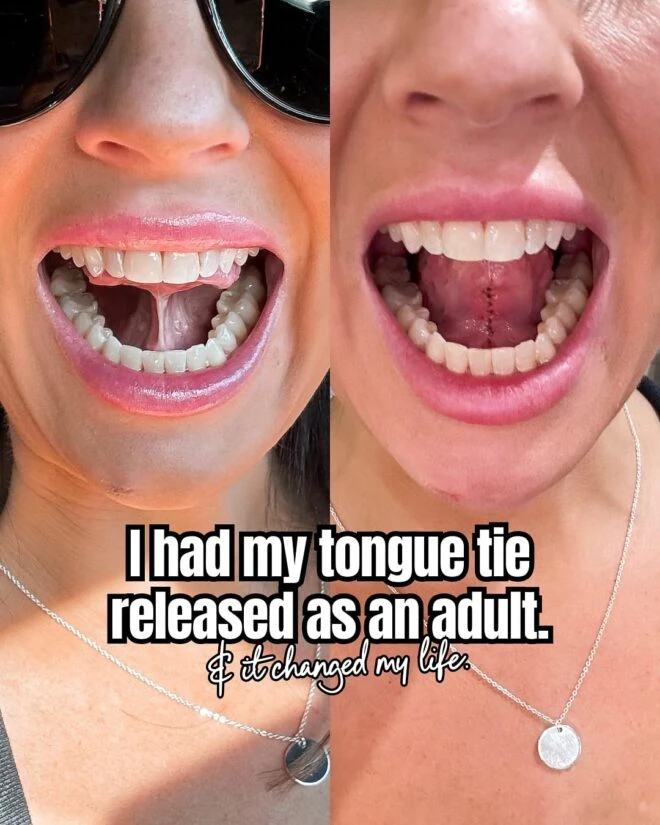
After months of therapy, I had my tongue tie released as an adult. The procedure took less than 15 minutes.
What happened next shocked me.
As the tissue was released, I felt tension melt out of my shoulders. When I stood up, my posture had changed. My neck wasn’t pulled forward anymore. Even my peripheral vision felt different.
That tiny piece of tissue had been pulling my entire body out of alignment.
Signs Parents Often Miss in Babies & Kids
Kelly explains that many things we’re told are “normal” actually aren’t.
Some red flags include:
- Difficulty latching or milk dribbling during feeds
- Excessive spit-up or colic
- Dark circles under the eyes (a sign of airway issues)
- Mouth breathing or snoring
- Restless sleep or bedwetting after potty training
- Grinding teeth or frequent ear issues
Common doesn’t mean normal.
Pacifiers, Mouth Breathing & Facial Development
One of the most eye-opening parts of this episode is how pacifiers and mouth breathing affect facial growth.
Your tongue is meant to rest gently suctioned to the roof of your mouth. When a pacifier sits there instead—especially beyond age one—the tongue drops, the palate narrows, and the airway can shrink.
Over time, this can lead to:
- Narrow faces and high palates
- Crowded teeth
- Poor sleep and breathing
- Increased need for orthodontic expansion later
Chewing, tongue posture, and nasal breathing are what help faces grow correctly.
Adults: It’s Not Too Late
If this wasn’t addressed in childhood, it often shows up in adulthood as:
- TMJ and jaw clicking
- Headaches and migraines
- Neck and shoulder tension
- Sleep apnea or poor sleep quality
- Anxiety, depression, and nervous system dysregulation
- Digestive issues like reflux, bloating, or constipation
For many adults, therapy before a tongue tie release is critical. Releasing tissue without retraining muscles can actually make symptoms worse.
The goal isn’t a quick fix—it’s changing lifelong compensation patterns.
Why This Affects Hormones, Anxiety & Weight
Poor sleep and mouth breathing increase inflammation and disrupt hormones like leptin and ghrelin (which regulate hunger and fullness).
That’s why so many people struggle with:
- Weight that won’t budge
- Chronic fatigue
- Anxiety or constant “air hunger”
- Feeling stuck in fight-or-flight
Breathing slower, through your nose, with your tongue in the right position sends safety signals to your nervous system.
Your body finally gets to rest.
Where to Start If This Sounds Like You
If this episode lit something up for you, start with:
- Awareness of tongue posture and nasal breathing
- Watching how your child sleeps
- Seeking a myofunctional therapist before considering procedures
This work is about root causes, not band-aid solutions.
Links & Resources Mentioned
- MyMyo My Health – Myofunctional therapy practice
- Xlear Nasal Spray – Saline nasal hygiene
- Myo Munchee – Chewing tool for oral development
- The Breathe Institute – Airway research and education





 Previous Post

Comments